Amorphous Alloys made by Heraeus AMLOY
Due to their unique material properties such as high strength combined with high elasticity, corrosion resistance and biocompatibility, amorphous alloys - also known as bulk metallic glasses or amorphous metals - open up completely new possibilities for engineers. Our portfolio includes amorphous alloys based on zirconium. In addition, we are currently researching alloys based on titanium.
Amorphous alloys enable extended product lifetime through corrosion resistance and reduced abrasion. Enabled by the high strength of the material, they also play an important role in miniaturization. Isotropic behavior facilitates the simplification of specifications and product designs. At Heraeus AMLOY, amorphous alloys are processed by injection molding and 3D printing into near-net-shape components at industrial scale.
AMLOY-ZR01 - Ideally suited for 3D printing
The zirconium-based alloy AMLOY-ZR01 is ideally suited for processing in 3D printing using the selective laser melting process. Complex geometries and also large component dimensions are realized by an isotropic material behavior. The material is characterized within the AMLOY alloy range by its good ductility. Additive manufacturing of amorphous metals can be used to produce individual components as well as specific surface structures with extraordinary properties.
AMLOY-ZR02 - The Allrounder Material
The zirconium-based alloy AMLOY-ZR02 is an allrounder material. Whether in additive manufacturing or injection molding, both near-net-shape process technologies enable the production of components in tight tolerances and with high surface qualities. Due to the versatile use of this alloy, large component dimensions can be produced in small to medium series in 3D printing as well as in large series with efficient automation in injection molding.
AMLOY-NI01 – Maximum Performance for Demanding Applications
The nickel–niobium-based alloy AMLOY-NI01 is designed for applications requiring maximum mechanical performance. Compared to conventional materials and zirconium-based metallic glasses, it offers significantly higher strength and hardness while maintaining a relevant level of toughness. This unique combination enables the use of AMLOY-NI01 in highly loaded structural components and wear-critical applications weighing less than 5 grams.
Due to its amorphous structure, the material exhibits an isotropic behavior and excellent resistance to deformation and wear. However, due to its limited glass-forming ability, AMLOY-NI01 is particularly suited for small or thin components (up to 1.5 mm wall thickness), such as cutting edges, small gears or mechanical components in watchmaking, where its exceptional material properties can be fully utilized.
AMLOY-CU01 – Precision and wear resistance for delicate, high-performance components
AMLOY-CU01 is a copper-based amorphous alloy characterized by high strength, excellent elasticity, and exceptional wear resistance. Thanks to its isotropic structure and high surface quality, it is particularly well-suited for small, complex, and thin-walled precision components such as gears, micromechanical components, or applications in the medical and watchmaking industries. Precision die-casting allows for tight tolerances and highly reproducible manufacturing.
Comparison of Materialproperties
| Property | AMLOY-ZR01 | AMLOY-ZR02 | AMLOY-NI01 | AMLOY-CU01 |
|---|---|---|---|---|
| Density (g/cm3) | 6,68 | 6,65 | 8,5 | 6,89 |
| Liquidus temperature (°C) | 920 | 870 | 1250 | 890 |
| Solidus temperature (°C) | 870 | 781 | 1190 | 800 |
| Glass transition temperature Tg (°C) | 400 | 403 | 650 | 400 |
| Crystalization temperature Tx (°C) | 475 | 469 | 700 | 445 |
| Crystallization entahlpy ∆H (J/g) | -47 | -47 | -63,9 | -122,6 |
| Young‘s modulus (GPa) | 87 | 89 | 124 | 105 |
| Poisson‘s ratio | 0,35 | 0,37 | 0,39 | 0,39 |
| Bending yield strength (GPa) | 2,3 | 2 | 4,4 | 2,4 |
| Tensile yield strength (GPa) | 1,6 | 1,7 | 2,9 | 2,0 |
| Compressive yield strength (GPa) | 1,7 | 1,6 | 3,0 | 2,1 |
| Vickers Hardness (HV5) | 480 | 500 | 860 | 570 |
| Datasheet | AMLOY-ZR01 | AMLOY-ZR02 | AMLOY_NI01 | AMLOY-CU01 |
Additionally, we are currently researching alloys based on titanium.
General Information about Amorphous Metals
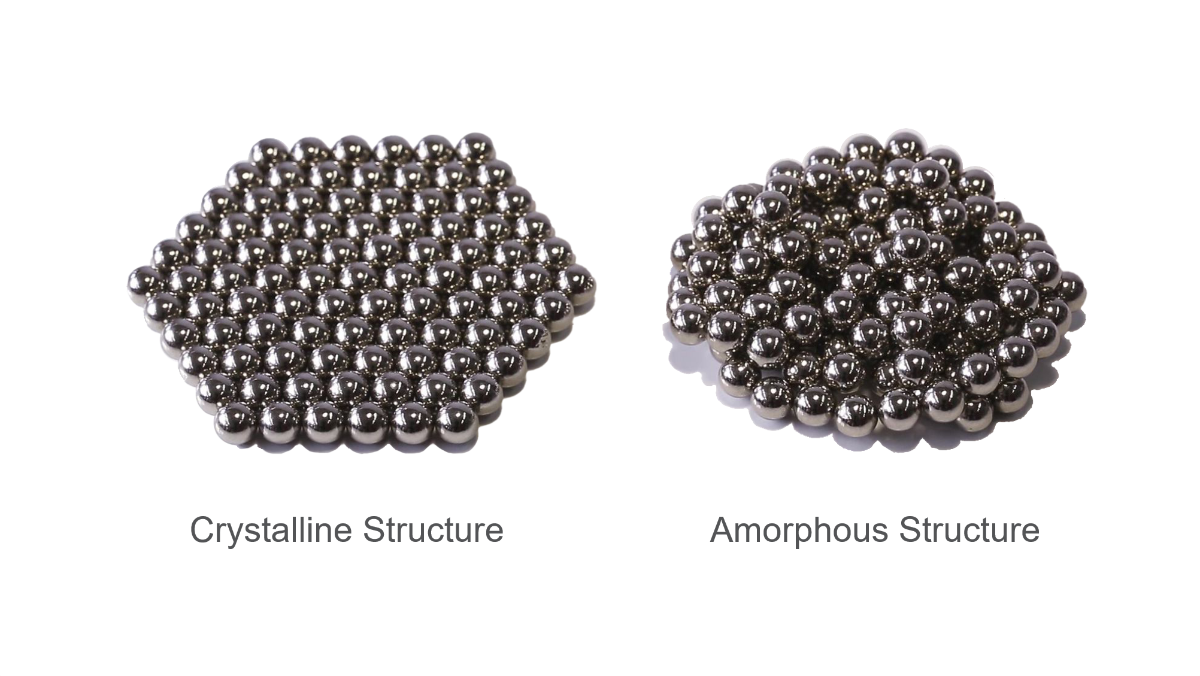
Amorphous metals are formed by the shock freezing of metallic melts. The atoms have no opportunity to form a crystalline lattice and solidify in a disordered manner (amorphous). Since the phase transformation from liquid to solid is suppressed in this process, no crystallization nuclei are formed during solidification. These defects in the lattice structure of conventional metals influence the mechanical and electromagnetic properties and lead, for example, to the material showing an increased tendency to corrosion, being brittle or cracking more quickly. By using amorphous metals, these risks can be avoided.